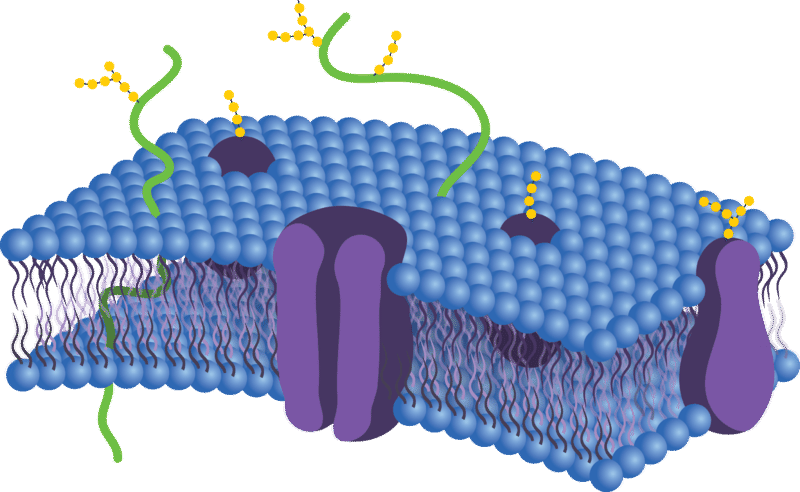
The cell membrane, also called the plasma membrane, is found in all cells and separates the interior of the cell from the outside environment. The cell membrane consists of a lipid bilayer that is semipermeable. The cell membrane regulates the transport of materials entering and exiting the cell.
The plasma membrane, or the cell membrane, provides protection for a cell. It also provides a fixed environment inside the cell, and that membrane has several different functions. One is to transport nutrients into the cell and also to transport toxic substances out of the cell. Another is that the membrane of the cell, which would be the plasma membrane, will have proteins on it which interact with other cells. Those proteins can be glycoproteins, meaning there's a sugar and a protein moiety, or they could be lipid proteins, meaning that there's a fat and a protein. And those proteins which stick outside of the plasma membrane will allow for one cell to interact with another cell. The cell membrane also provides some structural support for a cell. And there are different types of plasma membranes in different types of cells, and the plasma membrane has in it in general a lot of cholesterol as its lipid component. That's different from certain other membranes from within the cell. Now, there are different plants and different microbes, such as bacteria and algae, which have different protective mechanisms. In fact, they have a cell wall outside of them, and that cell wall is much tougher and is structurally more sound than a plasma membrane is.
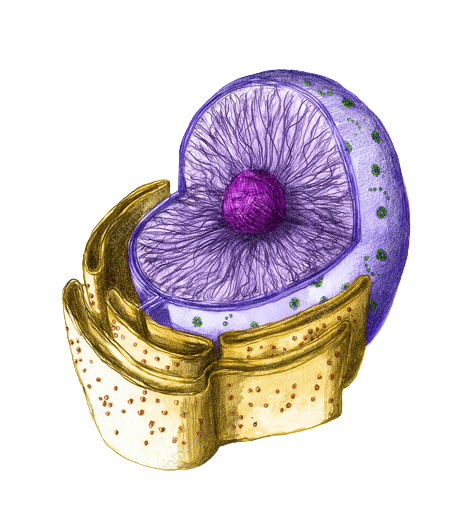
A nucleus, as related to genomics, is the membrane-enclosed organelle within a cell that contains the chromosomes. An array of holes, or pores, in the nuclear membrane allows for the selective passage of certain molecules (such as proteins and nucleic acids) into and out of the nucleus.
The nucleus is one of the most obvious parts of the cell when you look at a picture of the cell. It's in the middle of the cell, and the nucleus contains all of the cell's chromosomes, which encode the genetic material. So this is really an important part of the cell to protect. The nucleus has a membrane around it that keeps all the chromosomes inside and makes the distinction between the chromosomes being inside the nucleus and the other organelles and components of the cell staying outside. Sometimes things like RNA need to traffic between the nucleus and the cytoplasm, and so there are pores in this nuclear membrane that allow molecules to go in and out of the nucleus. It used to be thought that the nuclear membrane only allowed molecules to go out, but now it's realized that there is an active process also for bringing molecules into the nucleus.
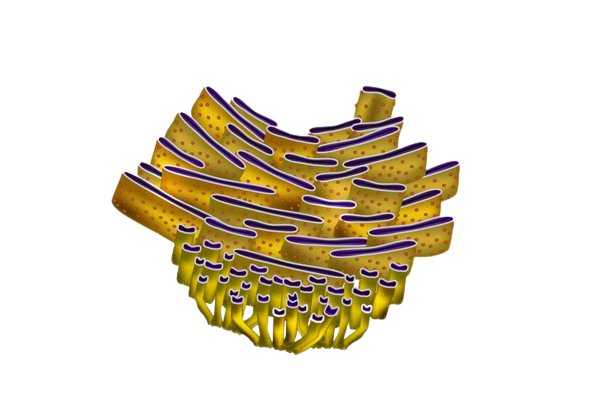
Endoplasmic reticulum is a network of membranes inside a cell through which proteins and other molecules move. Proteins are assembled at organelles called ribosomes. When proteins are destined to be part of the cell membrane or exported from the cell, the ribosomes assembling them attach to the endoplasmic reticulum, giving it a rough appearance. Smooth endoplasmic reticulum lacks ribosomes and helps synthesize and concentrate various substances needed by the cell.
The endoplasmic reticulum can either be smooth or rough, and in general its function is to produce proteins for the rest of the cell to function. The rough endoplasmic reticulum has on it ribosomes, which are small, round organelles whose function it is to make those proteins. Sometimes, when those proteins are made improperly, the proteins stay within the endoplasmic reticulum. They're retained and the endoplasmic reticulum becomes engorged because it seems to be constipated, in a way, and the proteins don't get out where they're suppose to go. Then there's the smooth endoplasmic reticulum, which doesn't have those ribosomes on it. And that smooth endoplasmic reticulum produces other substances needed by the cell. So the endoplasmic reticulum is an organelle that's really a workhorse in producing proteins and substances needed by the rest of the cell.
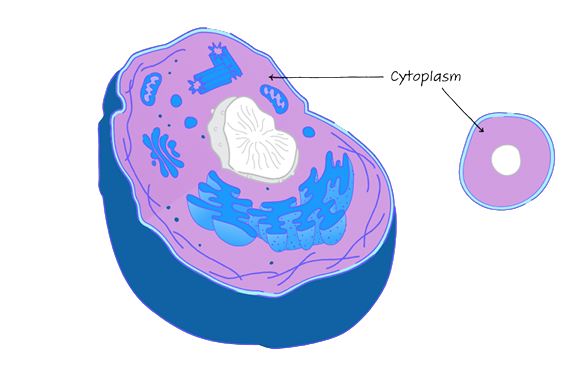
Cytoplasm is the gelatinous liquid that fills the inside of a cell. It is composed of water, salts, and various organic molecules. Some intracellular organelles, such the nucleus and mitochondria, are enclosed by membranes that separate them from the cytoplasm.
Cytoplasm's a funny term. So what does "cyto" mean? "Cyto" means "cell", "plasm" means "stuff", so it's "cell stuff". So think about a cell as a big water balloon, and the water balloon has little pieces of fruit floating around in it. And the cytoplasm is the water in the water balloon, and it's a little bit thicker than water, but it makes up the majority of the inside of most cells. Now, inside the cell, inside that water balloon, there's a nucleus and there's other so-called organelles, like mitochondria, or lysosomes, or the endoplasmic reticulum and other unpronounceable organelles, but the cytoplasm is the ocean in which all of these organelles float.
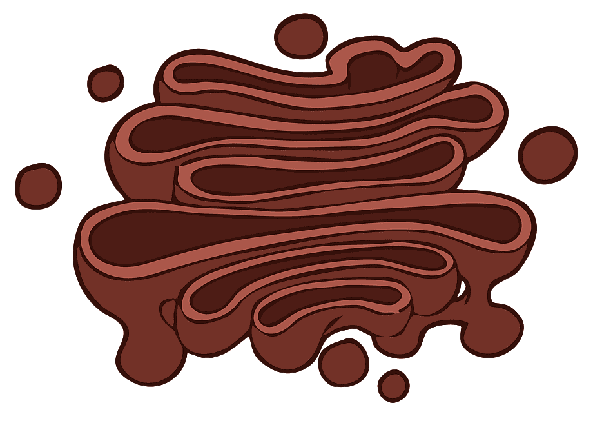
A Golgi body, also known as a Golgi apparatus, is a cell organelle that helps process and package proteins and lipid molecules, especially proteins destined to be exported from the cell. Named after its discoverer, Camillo Golgi, the Golgi body appears as a series of stacked membranes.
The Golgi body is a portion of the cell that's made up of membranes, and there's different types of membranes. Some of them are tubules, and some of them are vesicles. The Golgi is located right near the nucleus. It's called a perinuclear body, and it's actually right near the endoplasmic reticulum as well. And when proteins come out of the endoplasmic reticulum, they go into the Golgi for further processing. For example, carbohydrates are put on some of the proteins, and then afterwards these glycoproteins--meaning they have carbohydrate as well as protein on them, these glycoproteins move out of the Golgi to the rest of the cell. And they do so inside other vesicles. Those vesicles are actually made from the Golgi network. In fact, one of the functions of the Golgi is to make new vesicles out of the existing membrane of the Golgi and put into those vesicles the glycoproteins and other substances that are made in the Golgi network. And then those vesicles, filled with the Golgi products, move to the rest of the cell, usually through the cell to the plasma membrane, which is their end destination.
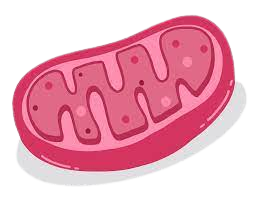
Mitochondria are membrane-bound cell organelles (mitochondrion, singular) that generate most of the chemical energy needed to power the cell's biochemical reactions. Chemical energy produced by the mitochondria is stored in a small molecule called adenosine triphosphate (ATP). Mitochondria contain their own small chromosomes. Generally, mitochondria, and therefore mitochondrial DNA, are inherited only from the mother.
Mitochondria are membrane-bound organelles, but they're membrane-bound with two different membranes. And that's quite unusual for an intercellular organelle. Those membranes function in the purpose of mitochondria, which is essentially to produce energy. That energy is produced by having chemicals within the cell go through pathways, in other words, be converted. And the process of that conversion produces energy in the form of ATP, because the phosphate is a high-energy bond and provides energy for other reactions within the cell. So the mitochondria's purpose is to produce that energy. Some different cells have different amounts of mitochondria because they need more energy. So for example, the muscle has a lot of mitochondria, the liver does too, the kidney as well, and to a certain extent, the brain, which lives off of the energy those mitochondria produce. So if you have a defect in the pathways that the mitochondria usually functions with, you're going to have symptoms in the muscle, in the brain, sometimes in the kidneys as well; many different types of symptoms. And we probably don't know all of the different diseases that mitochondrial dysfunction causes.
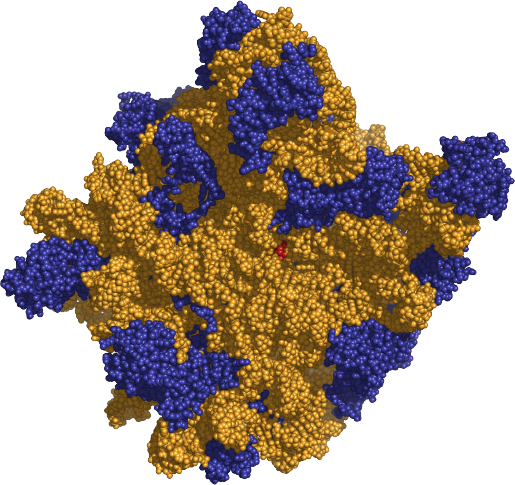
A ribosome is an intercellular structure made of both RNA and protein, and it is the site of protein synthesis in the cell. The ribosome reads the messenger RNA (mRNA) sequence and translates that genetic code into a specified string of amino acids, which grow into long chains that fold to form proteins.
A ribosome is the cellular machinery responsible for making proteins. There are many ribosomes in each cell, each made up of two subunits. These two subunits lock around the messenger RNA and then travel along the length of the messenger RNA molecule reading each three-letter codon. The ribosome serves as a docking station for the transfer RNA that matches the sequence of bases on the messenger RNA. Each three-letter codon on the messenger RNA pairs with the matching anticodon on a specific transfer RNA, and that specific RNA allows for the addition of a specific amino acid on the end of the growing protein chain. The ribosome then breaks up after the completion of the protein.
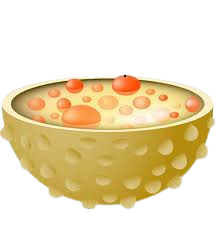
A lysosome is a membrane-bound cell organelle that contains digestive enzymes. Lysosomes are involved with various cell processes. They break down excess or worn-out cell parts. They may be used to destroy invading viruses and bacteria. If the cell is damaged beyond repair, lysosomes can help it to self-destruct in a process called programmed cell death, or apoptosis.
Now, the lysosome is a specific type of organelle that's very acidic. So that means that it has to be protected from the rest of the inside of the cell. It's a compartment, then, that has a membrane around it that stores the digestive enzymes that require this acid, low-pH environment. Those enzymes are called hydrolytic enzymes, and they break down large molecules into small molecules. For example, large proteins into amino acids, or large carbohydrates into simple sugars, or large lipids into single fatty acids. And when they do that, they provide for the rest of the cell the nutrients that it needs to... So, for example, if you can't do that, it can't break down large molecules into small molecules. You'll have storage of those large molecules, and this is a disease. There's also another type of lysosome storage disease in which the small molecules that are produced from those large molecules can't get out of the lysosome. They're stored there because the transporters for moving these small molecules out are missing genetically. And finally, one other function of the lysosome is to ingest bacteria so that the bacteria can be destroyed. So the lysosomes also provide a function against infection, and the cell will often engorge a bacterium and put it into its lysosome for destruction. So here's an important organelle that has function against infection and function in a way in nutrition to break down large molecules into small molecules so that they can be reutilized.
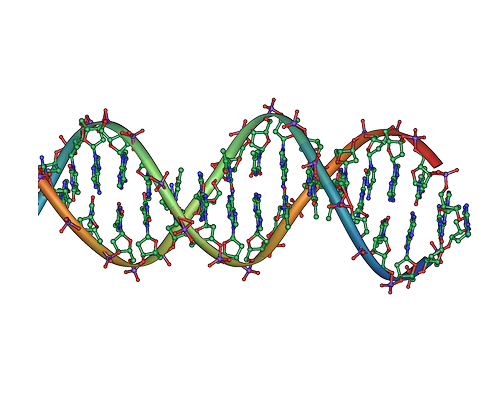
Deoxyribonucleic acid (abbreviated DNA) is the molecule that carries genetic information for the development and functioning of an organism. DNA is made of two linked strands that wind around each other to resemble a twisted ladder — a shape known as a double helix. Each strand has a backbone made of alternating sugar (deoxyribose) and phosphate groups. Attached to each sugar is one of four bases: adenine (A), cytosine (C), guanine (G) or thymine (T). The two strands are connected by chemical bonds between the bases: adenine bonds with thymine, and cytosine bonds with guanine. The sequence of the bases along DNA’s backbone encodes biological information, such as the instructions for making a protein or RNA molecule.
Is there a more amazing molecule than DNA? It makes each of us who we are. The more scientists understand it, the more we all understand ourselves, one another, and the world around us. For example, did you know that we are all far more alike than we are different? In fact, the DNA from any two people is 99.9% identical, with that shared blueprint guiding our development and forming a common thread across the world. The differing 0.1% contains variations that influence our uniqueness, which when combined with our environmental and social contexts give us our abilities, our health, our behavior. How can one, single molecule contain so much mystery and wonder? We are only beginning to understand the answer to that question, which is what makes the study of DNA so exciting.