According to Hooke's Law,
For Elastic Deformation in a Spring, Restoring Force(F) ∝ Change In Length(x)
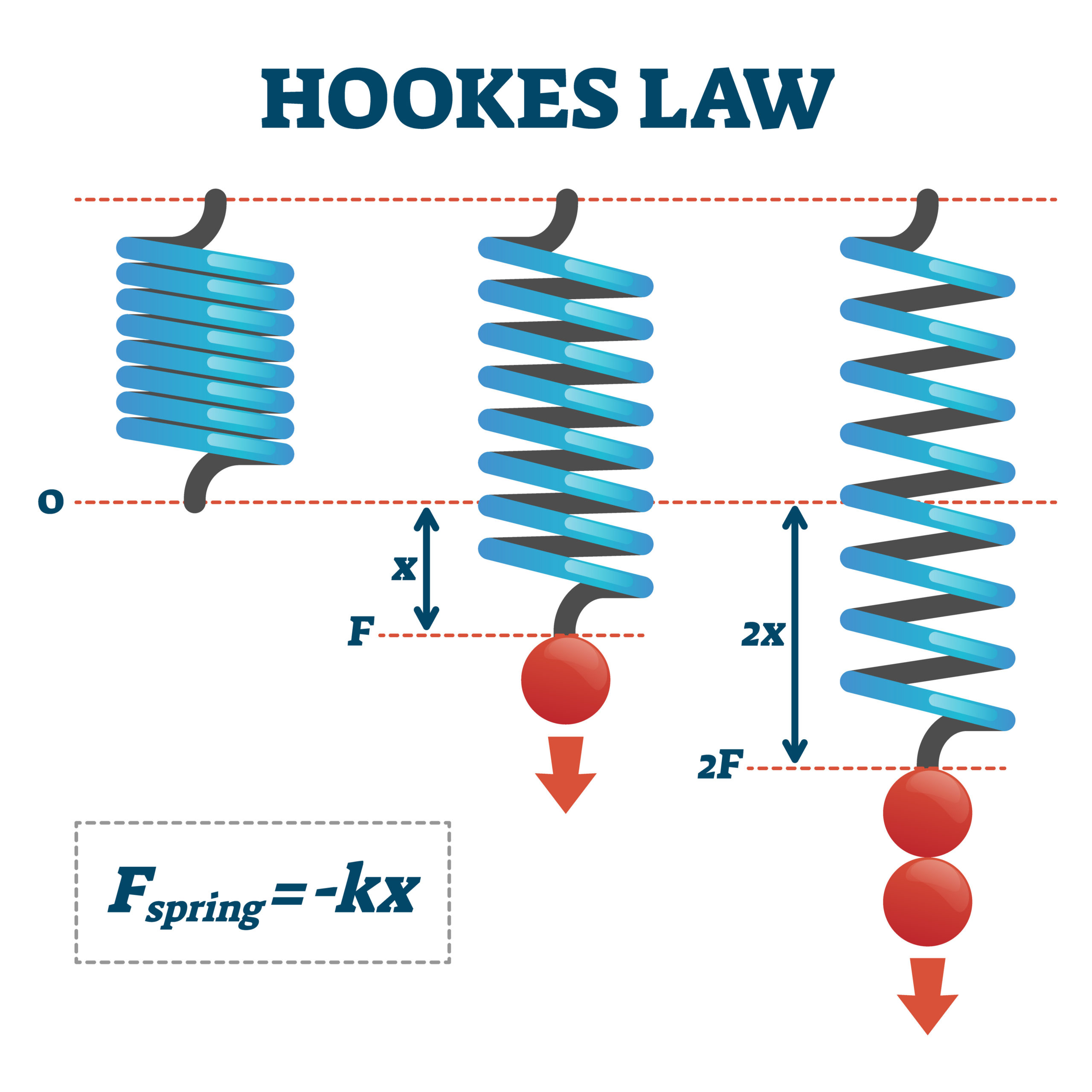
Fs = -kx Let the above equation be eq.1
According to Newton's Second Law,
Fnet = ma
⇒ Fnet = m(d2x/dt2) [∵ acc. is equal to the 2nd derivative of position or derivative of velocity]
Let the above equation be eq.2
Substituting eq.2 in eq.1 we get, Fs = -kx = m(d2x/dt2) Solving this differential eq. for x(t) or x as a function of time gives us, x = Acos(ωt+Φ)Where, A is amplitude, ω is angular frequency and Φ is the phase angle ⇒ dx/dt = -Aωsin(ωt+Φ) ⇒ d2x/dt2 = -Aω2cos(ωt+Φ) = ω2x This only holds true if, -ω2x + kx = 0 ⇒ ω2 = k/m ⇒ ω = √k/√m
This can be used to calculate weight of objects as well as astronauts in space.